This is a personal reflection on the ethical implications of so-called “neutrality” in online conflicts. When public accusations are made without accessible evidence, and when both sides are treated as equally untrustworthy by default, it creates a dangerous imbalance that favors the loudest voices, not the most truthful.
I wrote this in response to a recurring pattern I’ve seen across fandom spaces—one where demands for “proof” are selective, accountability is one-sided, and silence is mistaken for fairness.
There is a kind of voice that always arrives late—after the damage has been done, after reputations have been shattered, after someone has already broken down. It comes cloaked in reason, armed with symmetry, claiming to “see both sides” and lamenting how “no one can ever truly know the truth.”
This voice thinks it’s being wise. What it doesn’t realize is that it is already complicit.
Let’s be clear: when someone is accused of harassment, abuse, plagiarism, or mental instability—and the accusations are circulated widely, but the evidence remains inaccessible or deliberately withheld—it is not a neutral situation. It is a structurally loaded one.
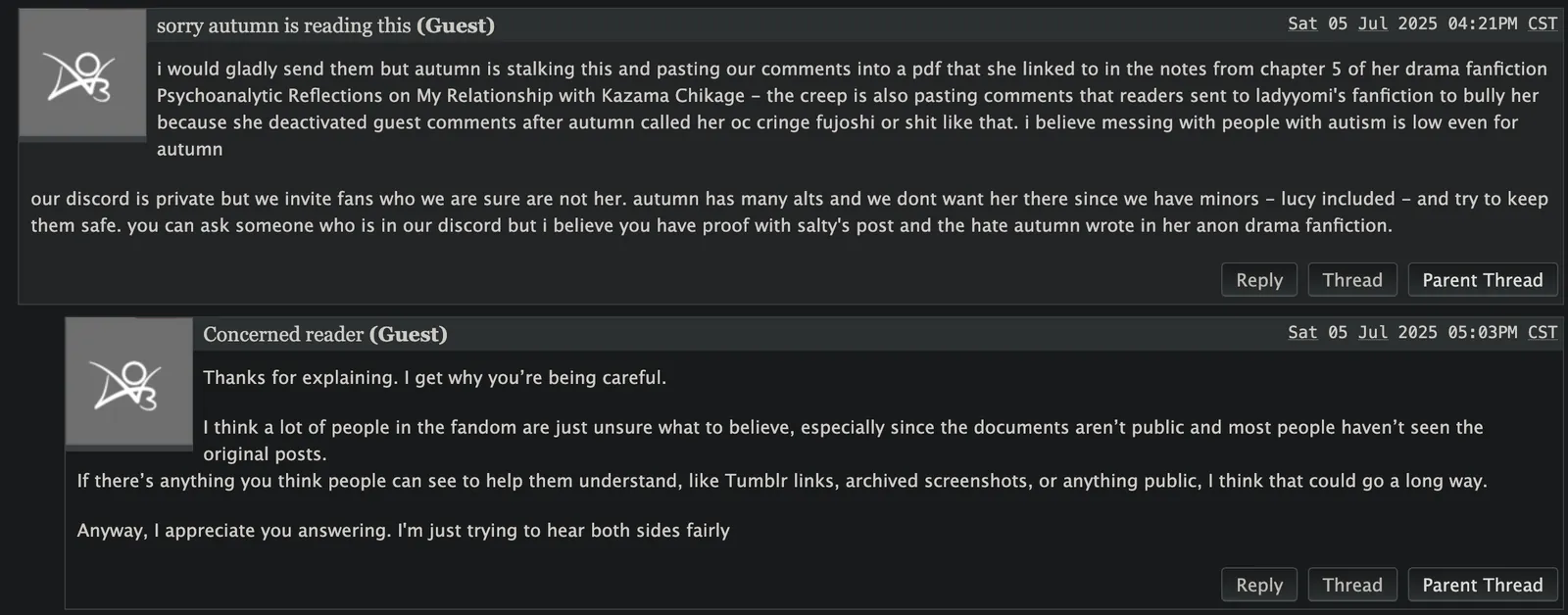
When one party says: “Here I am, you can see everything I’ve written, I demand you show proof,”
And the other says: “We have proof, but we won’t show you,”
There is no “equal ambiguity.” There is an asymmetry of power, deliberately maintained through opaque channels, rumor networks, and collective silence.
Figure 1
People love to pretend that withholding judgment is a form of moral high ground.
It isn’t.
It’s an ethical retreat.
You are not being “careful” by saying “maybe both sides did something wrong.”
You are flattening harm. You are abstracting pain into a thought experiment.
And most of all, you are placing the burden of proof on the wrong person—the one already being cornered, smeared, and silenced.
Do you know how exhausting it is to be asked to “prove you’re not that person” when the accusers refuse to even acknowledge your existence?
Do you know how cruel it is to demand transparency from the person already under fire, while giving total privacy to those hurling accusations from the shadows?
If your idea of fairness is to treat the knife and the wound as morally equivalent, you are not a neutral observer. You are part of the blade.
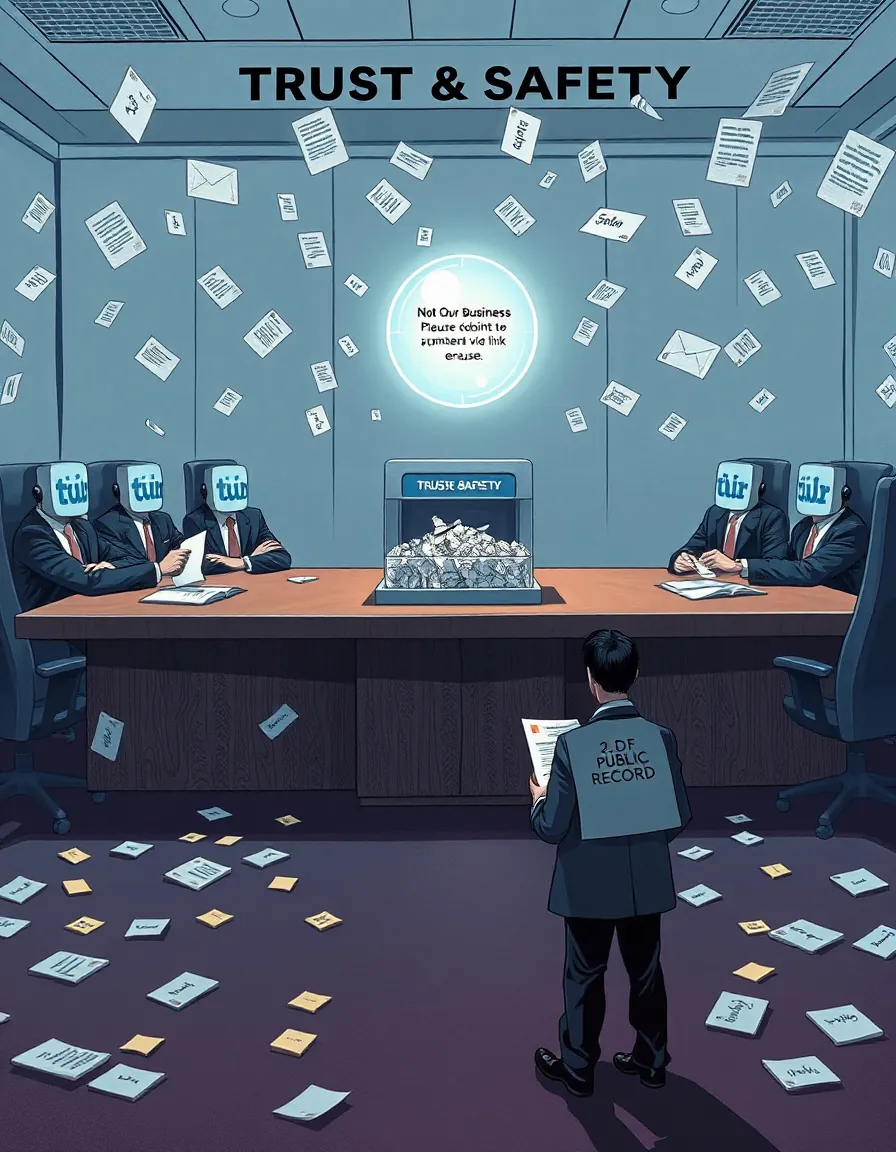
This piece was written weeks before Bluesky’s recent decision, which proved my point exactly.
This case is not only about Bluesky’s wrongful suspension. It’s about the complicit silence of multiple platforms that had the power — and the responsibility — to act.
I reached out to Google, Tumblr, and AO3 with detailed evidence of cross-platform harassment. None of them responded. Their inaction created a vacuum in which false accusations thrived, giving my harassers free rein to distort the narrative and escalate attacks.
Silence in the face of documented abuse is not neutrality. It is a choice that enables the abuser, and it is a betrayal of the communities these platforms claim to protect.